Three New Concentrations – Since Fall 2025 – Updates
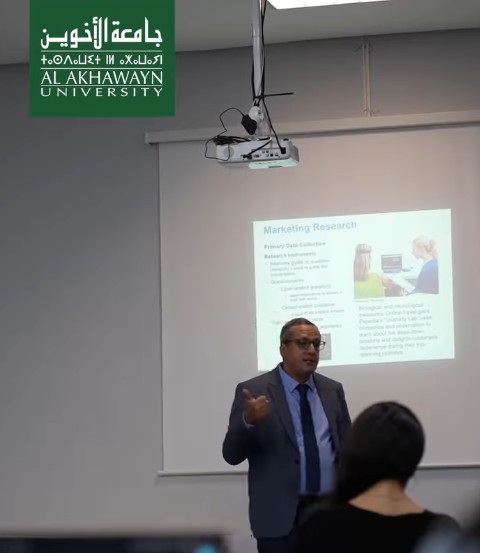
Dr. Yassine Bouchikhi, Undergraduate Program Director at the School of Business Administration at Al Akhawayn University, presents the new programs recently launched by the School. These innovative programs are designed to meet the growing demands of the job market, integrating the most in-demand skills of today and tomorrow. Our goal: to train future leaders equipped to tackle the challenges of a fast-changing world. Learn how the SBA continues to lead in business education—across management, finance, digital marketing, and more.
Concentration in Technology and Innovation Management
The concentration in Technology and Innovation Management (TIM) is designed for shaping professionals who can drive innovation and technology adoption. This concentration will offer a blend of technical and managerial skills, creating versatile professionals capable of adapting to various roles and industries. TIM graduates will bridge the gap between business and technology.
The TIM concentration consists of 15 semester credit hours (SCH), including 9 SCH of required courses and 6 SCH of electives:
Required Courses (9 SCH)
| Course Code | Course Name |
| TIM 3301 | Introduction to TIM (3 Credits) – Pre req MIS3301 |
| BAI 3301 | Introduction to Business Analytics (3 Credits) |
| TIM 3302 | Digital Transformation (3 Credits) |
- Introduction to TIM (3 SCH): This course introduces students to the fundamentals of technology and innovation management within a business context. It explores how organizations leverage emerging technologies and innovative practices to gain competitive advantage and drive growth. Students will learn key concepts such as technology adoption, innovation strategies, and the role of leadership in fostering a culture of innovation. Case studies and real-world examples will provide practical insights into managing technological change in dynamic markets.
- Digital Transformation (3 SCH): This course provides an overview of digital transformation and its impact on modern businesses. Students will explore how digital technologies such as AI, cloud computing, and data analytics are reshaping business models, operations, and customer experiences. The course emphasizes strategic approaches to managing digital change and aligning technology initiatives with organizational goals. Through case studies and hands-on activities, students will gain practical insights into leading successful digital transformation efforts.
- Introduction to Business Analytics (3 SCH): This course introduces the various types of data and how it can be used to make informed business decisions. Learners will explore the basic descriptive, inferential, and predictive statistical methods. The course also helps students acquire the skills they need in order to extract and unearth patterns, trends, and insights from the data. The course uses software packages to load data and perform some basic analytical 143 tasks, including Excel, Python, and SQL.
Two elective courses from the following courses* (6 SCH)
| Course Code | Course Name |
| MGT 4312 | Project Management (3 Credits) |
| CSC 3308 | Data Analysis (3 Credits) |
| FIN 3399 | Special Topic in Finance: Entrepreneurial Finance (3 Credits) |
| COM 5311 | Design Thinking (3 Credits) |
| BAI xxxx | Any BAI course |
Concentration in Sustainable Development and Social Enterprise
The concentration in Sustainable Development and Social Enterprise (SDE) has high potential in Morocco due to the increasing emphasis on sustainability, social impact and economic inclusivity. The country’s National Sustainable Development Strategy (NSDS) prioritizes green economy growth, resource management, and poverty reduction, directly supporting the demand for SDE expertise. Programs like the Green Morocco Plan and INDH (National Initiative for Human Development) and companies’ move to adopt ESG (Environmental, Social, and Governance) practices due to international trade partnerships, particularly with Europe support the need for the concentration.
The SDE concentration consists of 15 semester credit hours (SCH), including 9 SCH of required courses and 6 SCH of electives:
Required Courses (9 SCH)
| Course Code | Course Name |
| SDE 3301 | Introduction to SDE (3 Credits) – Pre req MGT3301 |
| SDE 3302 | Natural resource economics (3 Credits) |
| SDE 3303 | Impact investing (3 Credits) |
- Introduction to SDE (3 SCH): This course introduces students to the principles of sustainable development and the role of social enterprises in addressing global and local challenges. It explores how businesses can create social and environmental value alongside financial returns, with a focus on ethical decision-making, impact measurement, and sustainability frameworks. Students will examine real-world case studies and innovative business models that drive positive change. The course equips future business leaders with tools to integrate sustainability into core strategy and operations.
- Natural Resource Economics (3 SCH): This course provides an overview of natural resource economics with a focus on the efficient and sustainable use of natural resources. Students will explore economic principles related to resource allocation, conservation, and environmental policy. Topics include renewable and non-renewable resources, externalities, market failures, and the valuation of ecosystem services. The course equips students with analytical tools to evaluate resource management strategies from both economic and environmental perspectives.
- Impact Investing (3 SCH): This course introduces students to the growing field of impact investing, where financial returns are aligned with positive social and environmental outcomes. It covers key concepts such as investment strategies, impact measurement, risk management, and the role of various stakeholders in the impact ecosystem. Students will analyze real-world case studies and explore how capital can be leveraged to drive meaningful change. The course prepares future business leaders to evaluate and participate in investments that generate both profit and purpose.
Two elective courses from the following courses* (6 SCH)
| Course Code | Course Name |
| MGT 4312 | Project Management (3 Credits) |
| EGR 3281 | Sustainability and Energy Efficiency Competitions (3 Credits) |
| ENV xxxx | Any Environmental science course from SSAH |
Concentration in FinTech
A Bachelor of Business Administration (BBA) with a concentration Financial Technology, or FinTech (FIT) in Morocco holds significant potential as the country is rapidly embracing digital transformation across its financial and economic sectors. There is a growing FinTech ecosystem in Morocco with emerging startups and government support through initiatives such as Digital Morocco 2025, as well as a strategic regional role that Morocco plays as a gateway to Africa and its proximity to Europe, which will boost the FinTech growth and job opportunities in the country.
Required Courses (9 SCH)
| Course Code | Course Name |
| FIT 3301 | Introduction to FIT (3 Credits) – Pre req FIN3301 |
| FIT 3302 | Technology for Finance (3 Credits) |
| FIT 3303 | FinTech Business Models and Disruption (3 Credits) |
- Introduction to FIT (3 SCH): This course offers a foundational understanding of financial technology (FinTech) and its transformative role in the financial services industry. Students will explore key innovations such as digital payments, blockchain, robo-advisors, and peer-to-peer lending. The course examines how FinTech is disrupting traditional financial models and creating new opportunities for businesses and consumers. Emphasis is placed on emerging trends, regulatory considerations, and the strategic implications of FinTech in a digital economy.
- Technology for Finance (3 SCH): This course explores the intersection of technology and finance, focusing on how digital tools and innovations are reshaping financial decision-making and operations. Students will examine the use of technologies such as algorithmic trading, blockchain, data analytics, and financial modeling software in modern finance. The course highlights practical applications and strategic implications of technology in areas like investment management, risk assessment, and financial planning. Through case studies and hands-on projects, students will gain insight into the evolving landscape of tech-driven finance.
- FinTech Business Models and Disruption (3 SCH): This course delves into the innovative business models driving the FinTech revolution and their disruptive impact on traditional financial services. Students will analyze how startups and tech-driven firms are reshaping banking, lending, insurance, and investment through platform-based models and digital solutions. The course emphasizes critical evaluation of emerging trends, scalability, and the sustainability of FinTech innovations. Real-world case studies will provide insights into competitive dynamics, regulatory challenges, and strategic responses by incumbents and disruptors alike.
Two elective courses from the following courses* (6 SCH)
| Course Code | Course Name |
| FIN 3399 | Special Topics in Finance (3 Credits) |
| FIN 4306 | Financial Investments and Securities Analysis (3 Credits) |
| FIN 3303 | Corporate Financial Management (3 Credits) |
| FIN 3302 | Money and Banking (3 Credits) |
| FIT 3304 | Economics of cryptocurrencies (3 Credits) |
| FIT 3305 | Machine Learning in FinTech (3 Credits) |
| CSC 3308 | Data Analysis (with Python) (3 Credits) |
| CSC 4308 | Cybersecurity (3 Credits) |
| CSC 3358 | Blockchain Business Application (3 Credits) |